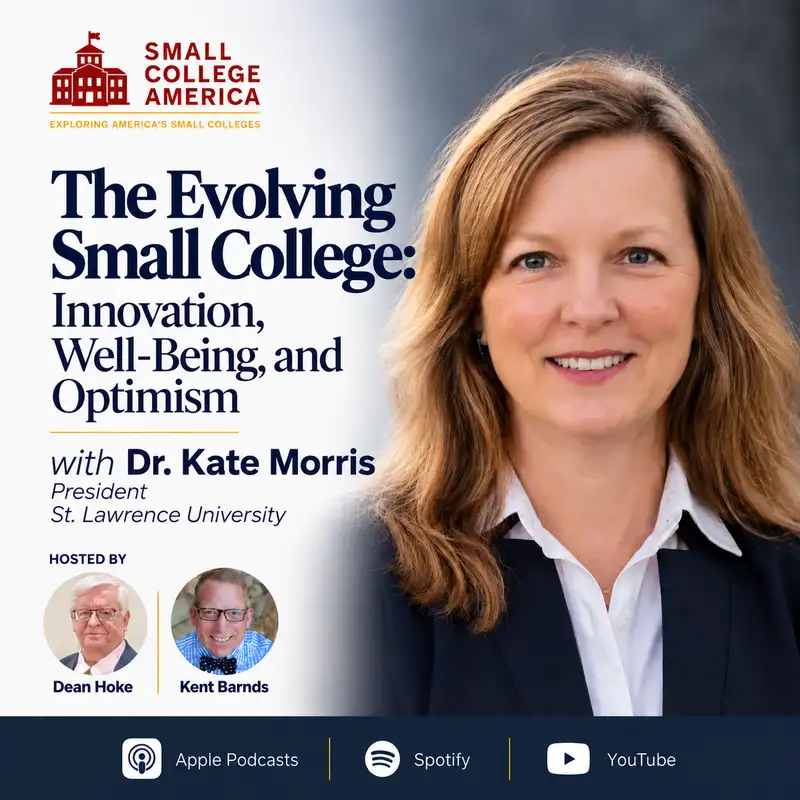
The Evolving Small College: Dr. Kate Morris President St. Lawrence University
Dean Hoke: Welcome to Small College America, a podcast dedicated to exploring the role and value of small colleges in the higher education landscape. I'm Dean Hoke, Co-Founder of Edu Alliance Group, and I’m joined by my co-host Kent Barnds, Executive Vice President of Augustana College,
Kent: Today, we're joined by Dr. Kate Morris, the 19th president of St. Lawrence University in Canton, New York. Kate became president in 2021 after a long career at Butler University, where she taught psychology and later served as provost and vice president for academic affairs. She earned her bachelor's degree at Gettysburg College and her graduate degrees in social psychology from the University of Texas at Austin. She also serves on Gettysburg's Board of Trustees, a connection that Kent, as a Gettysburg graduate, knows well.
And Kate, we discovered something unusual: you took up figure skating in your late thirties and even learned ice dancing. Given St. Lawrence's hockey tradition, you may be more comfortable on the ice than most college presidents! Kate, welcome to Small College America.
Interview Questions
Dean: Question 1: St. Lawrence, the North Country, and Your Journey
Kate, to begin, tell our listeners a little about St. Lawrence University and its community in Canton and the North Country. And how did your own journey—from teaching psychology at Butler to becoming a university president—bring you to St. Lawrence?
Kent: Question 2: Enrollment and Institutional Size
St. Lawrence, like many private liberal arts universities, has seen undergraduate enrollment decline from roughly 2,400 students a decade ago to around 1,800 today. As you look ahead, are you aiming to return to earlier enrollment levels, or do you envision a different long-term size for the university?
Dean: Question 3: Academic Innovation and the Liberal Arts Mission
St. Lawrence's mission is to provide an 'inspiring and demanding undergraduate education in the liberal arts.' Yet you've added majors in areas such as data science, finance, biomedical sciences, and public health. How do you decide which new programs respond to students' interests and career goals while remaining faithful to that liberal arts mission?
Kent: Question 4: Retention and the Student Experience
St. Lawrence reports first-year retention of approximately 90 percent. At a university where nearly every undergraduate lives on campus, the student experience matters especially. What have you done to improve retention, and what might other small residential colleges learn from that work? Has your background in social psychology shaped your approach to student belonging and well-being?
Dean: Question 5: Athletics and Enrollment
Athletics is a major part of student life at St. Lawrence, with roughly four in ten students participating in intercollegiate sports. You have Division I hockey alongside Division III programs, and you serve on the NCAA Division III Presidents Advisory Group. How do you see athletics' role changing at small residential colleges, especially in recruitment and enrollment?
Kent Question 6: Five Years From Now — St. Lawrence and Small Colleges
Kate, let's close by looking ahead five years. As you think about St. Lawrence and other small private colleges in 2031, what do you believe these institutions will need to do differently to remain academically strong and financially sustainable?
Dean: Kate, thank you for joining us and for helping us better understand St. Lawrence University, its distinctive community, and the opportunities and challenges facing small liberal arts colleges. We appreciate your perspective and your time.
For those listening or viewing, visit www.smallcollegeamerica.net to learn more about Small College America, find past and upcoming episodes, leave comments, and subscribe. On behalf of our guest, President Kate Morris, my co-host Kent Barnds, and me, thank you for joining us.