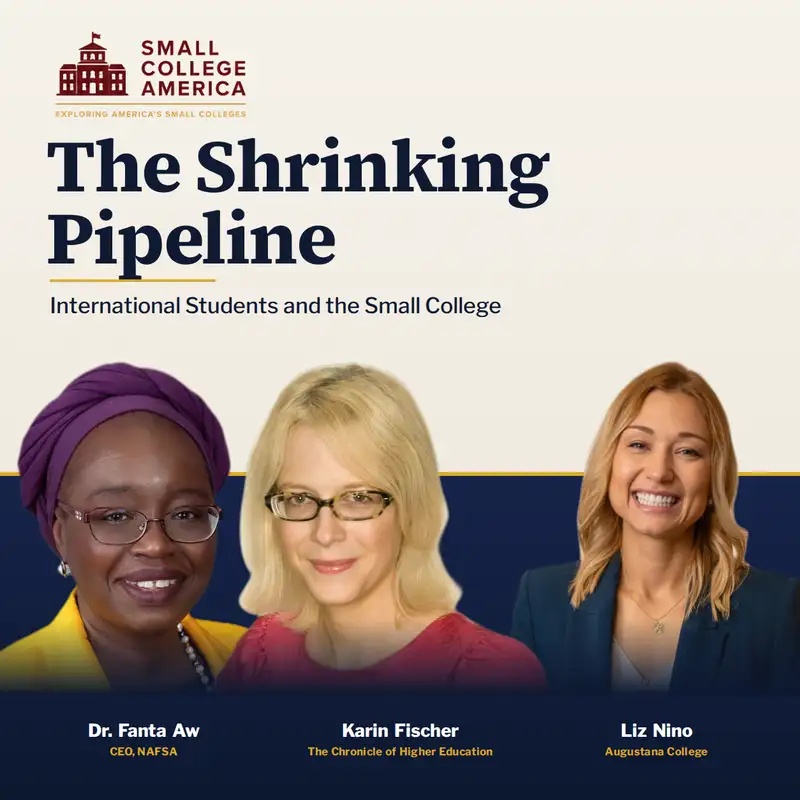
The Shrinking Pipeline: International Students and the Small College
Dean: Welcome to this live edition of Small College America and our Consequential Conversations series. I’m Dean Hoke, joined by my co-host Kent Barnds. Today we’re discussing “The Shrinking Pipeline: International Students and the Small College.” We’ll examine the current environment, what it means for smaller institutions, and the choices college leaders face.
Kent: We are joined by three people who bring distinct perspectives to international education.
Dr. Fanta Aw is Executive Director and CEO of NAFSA: Association of International Educators. She spent more than three decades at American University, including as Vice President of Undergraduate Enrollment, Campus Life, and Inclusive Excellence. She previously served as NAFSA’s elected President and Chair of its Board of Directors from 2013 to 2016, before returning as its CEO.
Karin Fischer is The Chronicle of Higher Education’s international reporter. For more than two decades, she has covered international students, study abroad, and the growing influence of geopolitics on higher education. She also writes Latitudes, The Chronicle’s newsletter on global education.
Liz Nino is Executive Director of International Enrollment at Augustana College. She has helped build Augustana’s international recruitment program and continues to travel extensively, meeting prospective students and families. She brings the perspective of someone navigating recruitment and enrollment decisions directly in the field. Fanta, Karin, and Liz, welcome to Small College America.
Dean: We’ll begin with a brief assessment from each guest, then move into paired discussions. Please submit questions throughout the program; we’ll address as many as time allows near the end.
Dean to Karin Fischer: Karin, from your reporting and conversations with students and institutions, how would you describe the international enrollment situation in the United States right now? What are the developments that deserve the most attention?
Kent to Fanta Aw: Fanta, from NAFSA’s perspective, how do you assess the current policy and international education environment? What are the most consequential uncertainties for students and institutions?
Dean to Liz Nino: Liz, when we interviewed you previously, we discussed Augustana’s success in building a substantial international student population. Since then, the recruitment environment has changed dramatically. You’re still traveling internationally and meeting directly with students and families. What are you hearing today that is different from even a year or two ago? And how are visa difficulties and changing perceptions of the United States affecting students’ decisions?
THE SMALL-COLLEGE DIFFERENCE Kent: Karin and Fanta, much of the national discussion treats international enrollment as a single higher education story. But Karin, you noted in our preparatory conversation that small colleges’ undergraduate focus may offer some protection compared with institutions dependent on graduate enrollment. Fanta, you also reminded us that small colleges differ widely in their resources, locations, and missions. How does the current situation affect small colleges differently from larger universities? And what separates institutions with room to adapt from those with fewer options?
MORE THAN A TUITION NUMBER Dean: Fanta and Liz, much of the discussion about declining international enrollment focuses on tuition revenue and institutional finances. But at many small colleges, international students are also an important part of the educational experience, bringing different perspectives into classrooms and campus life. How should small colleges think about the consequences of declining international enrollment beyond the financial impact? And what might be lost, particularly at residential institutions, if international students become a smaller part of the campus community?
THE CHANGING RECRUITMENT MARKET: Kent: Karin and Liz, international students have more choices about where to study, while universities in other countries are competing for their attention. At the same time, larger and better-known U.S. institutions can draw on established reputations and recruitment networks. What does this changing competitive landscape mean for a small college that may not be familiar to students and families abroad? And how can those institutions communicate the value of a residential liberal arts education when students are weighing reputation, affordability, safety, and visa uncertainty?
WHAT LEADERS SHOULD DO NOW: Dean: Fanta and Liz, some colleges are responding to the current uncertainty by considering reductions in international recruitment and redirecting resources toward domestic enrollment. Yet trusted relationships and recruitment pipelines can take years to build. For a small college under immediate budget pressure, how should leaders decide what to preserve, what to change, and where to invest? And what are the long-term risks of withdrawing now and trying to rebuild later?
FIVE-YEAR OUTLOOK: Kent: To the entire panel Looking five years ahead, what do you think will have changed most about international student enrollment at America’s small colleges? And what should presidents and boards be preparing for today?
AUDIENCE Q&A Note: During the session, we answered 4 or 5 questions
CLOSING: Kent: Thank you, Fanta, Karin, and Liz, for sharing your perspectives, and thanks to everyone who joined us. Today’s discussion reminds us that international enrollment is about more than a single year’s numbers: it touches institutional strategy, students’ opportunities, and the educational life of small colleges. For more Small College America conversations and interviews, visit smallcollegeamerica.net. Thank you for joining us.